Preventing Maritime Accidents Through Precision Tightening: Torque Management and NDT Standards for Lock Nuts

Precise torque control ensures optimal clamping force, eliminating bolt fatigue and self-loosening under cyclic marine vibration.
Non-Destructive Testing (NDT) verifies internal metallographic soundness and surface integrity without compromising hardware.
Engineered solutions like Safer Lock by Imjin S&T deliver fail-safe mechanical locking under extreme hydrodynamic loads.
Preventing catastrophic maritime structural failures requires combining precision torque management with rigorous non-destructive testing (NDT) protocols for anti-loosening fasteners. Proper clamp load calibration and defect-free hardware ensure critical shipboard joints withstand continuous engine vibrations and rough sea conditions.
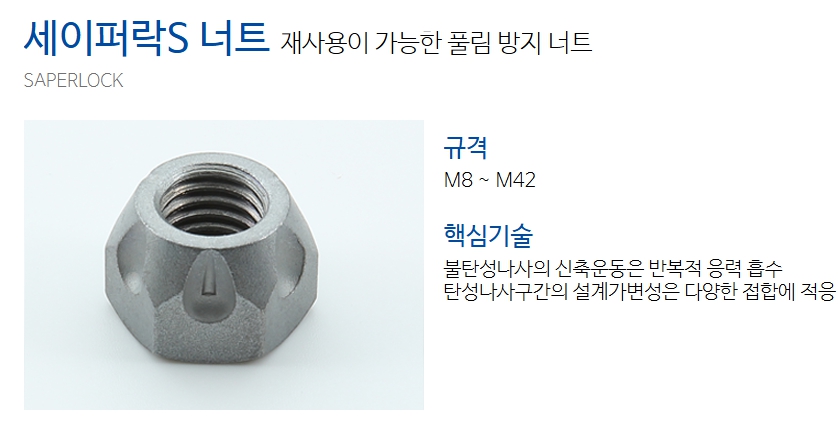
In offshore and marine engineering, bolted joints endure hostile operational environments. Constant hydrodynamic pounding, severe propulsion vibration, and thermal cycling continuously challenge fastener integrity. When a single critical joint fails at sea, the consequences range from expensive downtime to catastrophic structural compromise.
Why Is Torque Management Vital for Marine Fasteners?
A common misconception in heavy engineering is that applying maximum possible torque ensures joint safety. In reality, proper clamping force—not raw tightness—is what keeps a bolted joint intact.
When torque is applied to a nut, approximately 90% of the rotational force overcomes friction under the nut head and along the mating threads. Only roughly 10% converts directly into bolt tension, known as pre-load. If torque is uncontrolled, two major failure modes emerge:
Under-tightening: Insufficient clamp force allows micro-movement between joined plates. Under cyclic dynamic loads, this leads to rapid thread back-off and sudden joint separation.
Over-tightening: Excessive torque stretches the bolt past its yield point, causing plastic deformation, thread stripping, or immediate fatigue fracture under operational stress.
To withstand extreme propulsion dynamics, modern vessels rely on advanced locking fasteners. As explored in our guide on loosening prevention mechanisms in marine fastening, mechanical locking nuts maintain critical clamp load even when external shock loads attempt to rotate the fastener.
What Are the Standard NDT Protocols for Marine Lock Nuts?
Ensuring that a lock nut can endure severe operating conditions requires comprehensive material verification. Non-Destructive Testing (NDT) inspects critical fasteners for internal voids, micro-cracks, and forging defects without damaging the finished component.
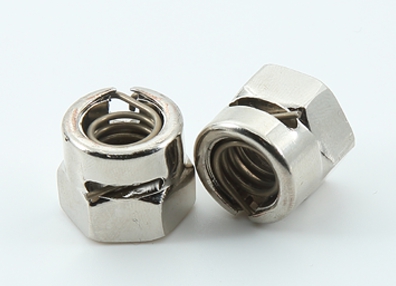
Detects surface and near-surface discontinuities in ferromagnetic steel nuts, identifying hairline forging cracks along the thread root.
Sends high-frequency sound waves through the fastener body to locate hidden internal inclusions, laminations, or sub-surface voids.
Used on non-ferrous and stainless steel alloys to highlight open-to-surface defects using fluorescent or visible dye developers.
Applies electromagnetic induction to evaluate thread surface flaws and verify proper heat treatment uniformity across large production batches.
Integrating these NDT methods into procurement and quality assurance ensures that every installed fastener meets maritime classification standards before deployment into mission-critical assemblies.
Evaluating Fastening Strategies: Standard vs. Engineered Lock Nuts
Fastener Type | Vibration Resistance | Maintenance Demand | Recommended Marine Application |
|---|---|---|---|
Standard Hex Nut + Split Washer | Low (Prone to flattening) | High (Frequent retorque required) | Non-critical cabin fittings, light brackets |
Nylon Insert Lock Nut | Moderate (Degrades with heat) | Moderate (Single-use limitation) | Auxiliary low-temperature deck equipment |
Double Nutting (Jam Nut) | Moderate (Operator sensitive) | High (Difficult torque control) | Secondary structural frames |
Safer Lock (All-Metal Mechanical) | Exceptional (Independent locking) | Minimal (Long-term reliability) | Propulsion, steering gear, heavy hull joints |
For large vessels where maintenance access is restricted and downtime costs are astronomical, engineered mechanical solutions provide the highest level of joint assurance. You can read more about safeguarding vessel architecture in our analysis on ensuring structural integrity in mega-vessels.
How Imjin S&T Delivers Reliable Fastening with Safer Lock
Manufactured by Imjin S&T, a specialized South Korean fastener innovator with decades of precision engineering expertise, Safer Lock is designed specifically to eliminate self-loosening in critical industrial and marine applications.
Unlike standard friction-dependent nuts or chemical locking adhesives that break down under sea spray and cyclic thermal stress, Safer Lock utilizes a patented dual-structure mechanical locking mechanism. When tightening torque is applied, the internal locking spring and nut body work synchronously, biting into the thread geometry to generate an unbreakable mechanical barrier against reverse rotation.
Imjin S&T applies strict quality assurance protocols, from raw material metallurgical inspection to comprehensive torque-tension testing and surface anti-corrosion treatments. For engineering teams preparing specifications, reviewing our guide on Safer Lock specifications before requesting a quote provides practical dimensional and grade selection criteria.
Verify bolt grade and nut property class compatibility prior to assembly.
Inspect mating threads for burrs, corrosion, or foreign debris.
Calibrate digital or mechanical torque wrenches according to project specifications.
Apply specified marine lubricant or anti-seize paste to control friction coefficient variance.
Perform cross-pattern tightening on multi-bolt flange joints in calibrated torque stages.
Frequently Asked Questions
How often should marine torque wrenches be calibrated?
In marine and offshore operations, torque wrenches should typically be calibrated every 6 to 12 months, or after every 5,000 cycles, depending on classification society guidelines and project-specific quality standards.
Can lock nuts like Safer Lock be reused after disassembly?
Yes, all-metal mechanical lock nuts such as Safer Lock are engineered for multiple reuses without losing their locking effectiveness, provided threads pass visual inspection and dimensions remain within tolerance.
Why do split spring washers fail in high-vibration marine environments?
Split spring washers often flatten completely under normal bolt pre-load, losing their elastic spring effect. Under severe dynamic shear loads, they can act as a low-friction bearing ring, accelerating rather than preventing nut back-off.
How does marine corrosion affect joint torque accuracy?
Corrosion increases thread friction significantly. If applying torque to a rusted fastener, most torque energy is consumed by thread friction rather than generating tension, resulting in dangerously low actual clamping force.

Leave your inquiry and our team will get back to you shortly.
📩 Imjin ST SaferLock Contact us